A wall mount garage door opener can completely change how your garage feels.
Instead of hanging from the ceiling in the middle of the garage, the opener sits beside the garage door and works directly with the torsion shaft.
That can free up ceiling space, reduce some vibration, and create a cleaner setup.
But that does not automatically make a wall-mounted opener the better choice.
For many homeowners, a traditional ceiling-mounted opener is still the simpler and more practical option.
The right choice depends on your garage door, available space, spring system, and how you use the garage.
Wall Mount vs. Ceiling Mount Garage Door Opener: Quick Comparison
A wall mount garage door opener is usually the better choice when you need open ceiling space or have a compatible torsion system. A ceiling-mounted opener is often more practical for standard garage layouts where the existing setup already works well.
| Feature | Wall Mount Opener | Ceiling Mount Opener |
| Mounting location | Beside the garage door | Ceiling |
| Drive system | Turns the torsion shaft | Uses a rail and trolley |
| Ceiling space | Leaves the center ceiling open | Uses overhead space |
| Torsion system | Generally required | Can work with torsion or extension springs, depending on model |
| Side clearance | Must be available | Less important |
| Noise and vibration | Often lower | Depends on drive type and installation |
| Installation | More model-specific | Usually more conventional |
| Best for | Space-conscious or compatible torsion setups | Standard garage layouts |
| Replacement flexibility | More limited by door hardware | Broad range of compatible options |
What Is a Wall Mount Garage Door Opener?
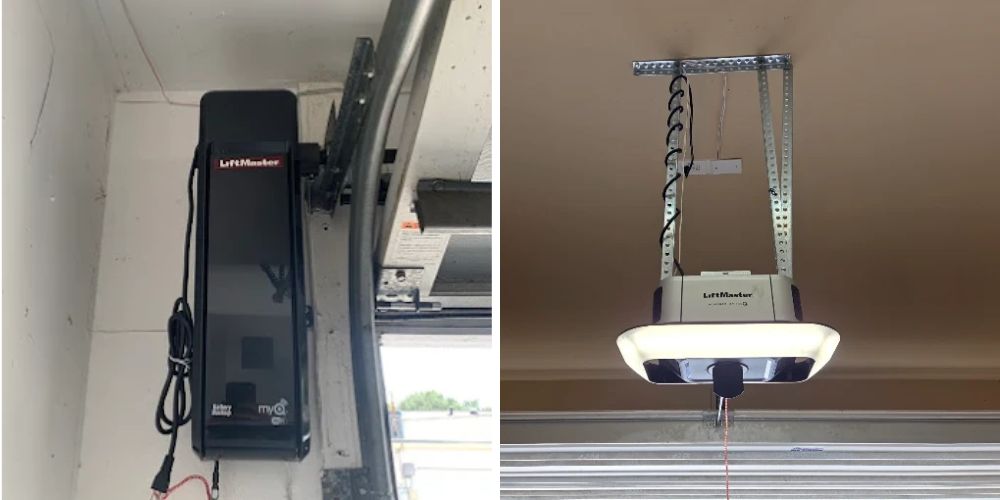
A wall mount garage door opener, also called a side-mount or jackshaft opener, installs beside the garage door rather than on the ceiling.
Instead of using a long overhead rail and trolley, the opener turns the garage door’s torsion shaft.
Think of it like moving the motor from the middle of the ceiling to the side of the door. The basic job stays the same, but the way the opener interacts with the garage door changes.
This design is especially useful when the ceiling is being used for storage, lighting, vehicle lifts, or other equipment.
It can also make sense when keeping the center of the garage open is more important than having a conventional opener layout.
How Is a Wall Mount Opener Different From a Ceiling Mount Opener?
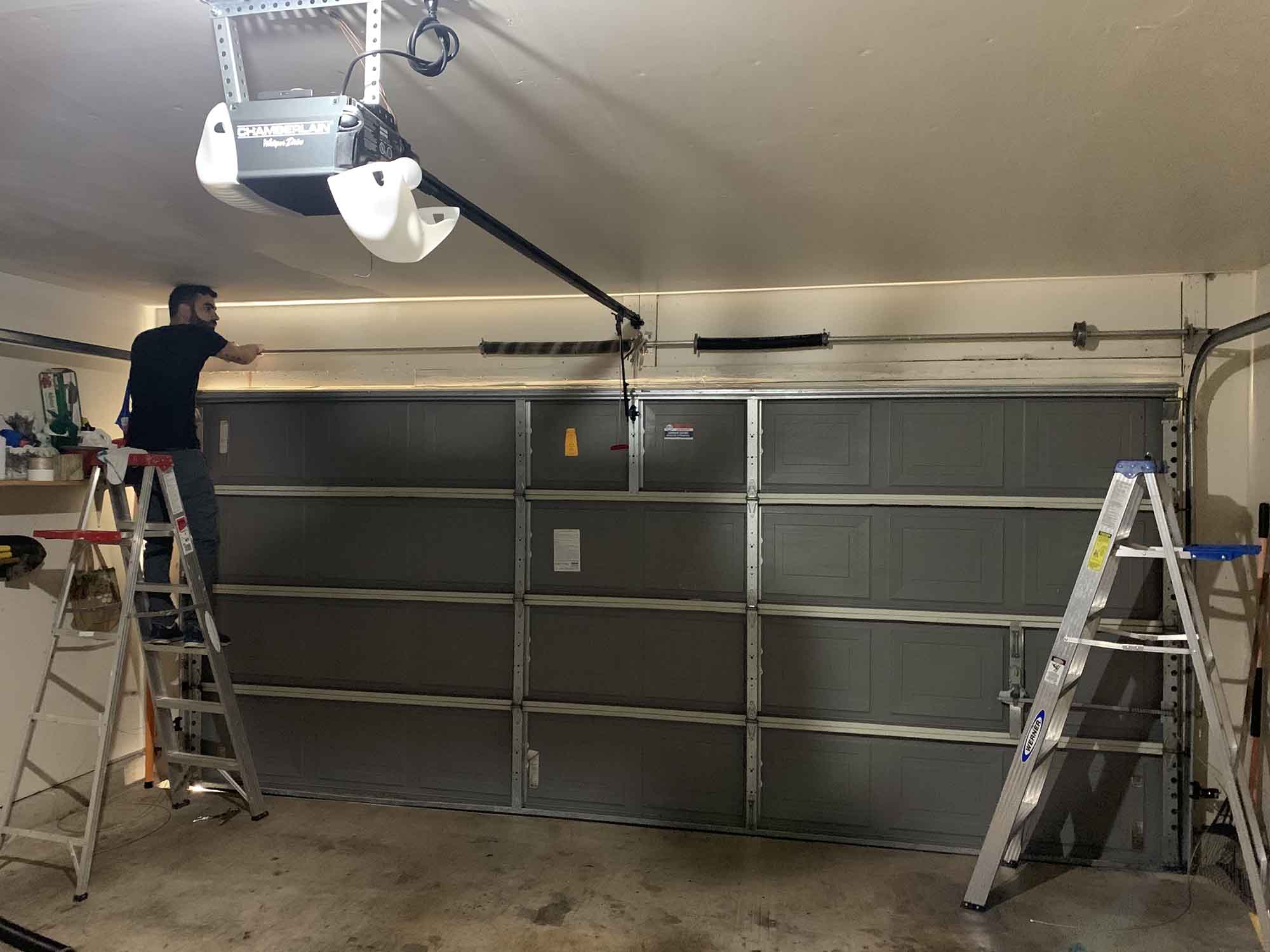
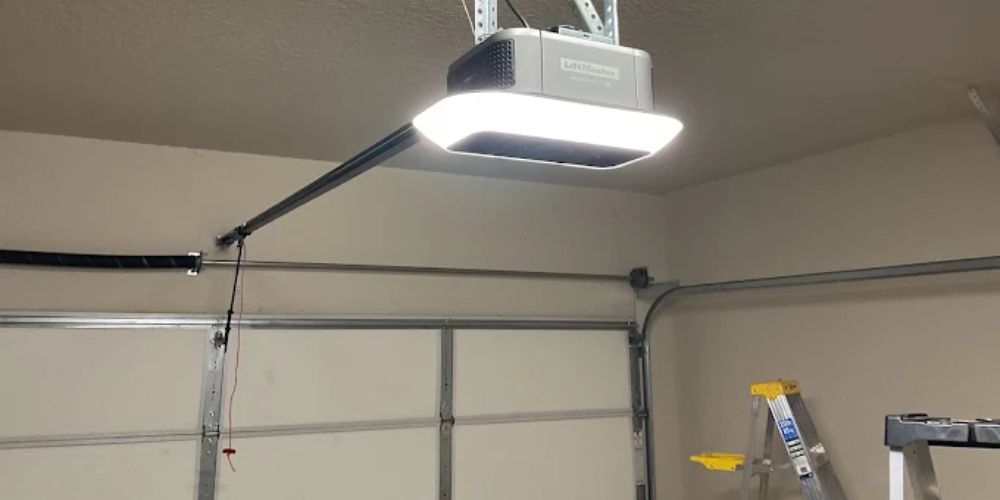
A traditional ceiling-mounted opener uses a motor and rail positioned above the garage door.
The motor moves a trolley along the rail, which is connected to the door with an arm.
A wall mount opener takes a different approach.
It mounts beside the door and rotates the torsion shaft that operates the door.
That means there is no long center rail running across the ceiling.
The difference sounds simple, but it affects several parts of the installation, including compatibility, available space, and how the opener interacts with the existing door hardware.
Why Choose a Wall Mount Garage Door Opener?
It Frees Up Ceiling Space
This is probably the biggest reason homeowners choose a wall-mounted opener.
The opener and rail no longer occupy the center of the ceiling.
A wall mount opener can also be useful in a garage with limited ceiling clearance, provided the door and torsion system meet the opener’s requirements.
That can be useful if you have:
- Overhead storage
- Low ceiling clearance
- Ceiling-mounted lights
- A vehicle lift
- Pipes or other obstructions
- A garage where you simply want more open space
If you already use your ceiling for storage, removing the rail can make the garage noticeably easier to organize.
It Can Reduce Vibration
A wall mount opener does not use the same long overhead rail and trolley arrangement as a traditional ceiling-mounted opener.
Because the motor is mounted beside the door, there can be less vibration transferred through the ceiling structure.
This can matter more in an attached garage, especially when there are bedrooms or living areas above it.
That does not mean every wall mount opener will be quieter than every ceiling opener. A properly installed belt-drive ceiling opener can also operate quietly.
The garage structure and condition of the door matter too.
It Creates a Cleaner Ceiling
Some homeowners simply prefer the appearance.
Without the motor, rail, and hanging supports in the middle of the garage, the ceiling looks less crowded.
This can be particularly useful in garages that have been finished as workshops, storage areas, or multipurpose spaces.
What Are the Disadvantages of a Wall Mount Garage Door Opener?
A wall mount opener is not the right answer for every garage.
The biggest disadvantage is compatibility.
Most residential wall mount systems are designed around a compatible torsion-spring and torsion-shaft arrangement. If your garage door uses a different spring or hardware configuration, the opener may not be a direct replacement.
Side clearance is another consideration.
The opener needs a suitable mounting location beside the door, and the torsion shaft needs to meet the manufacturer’s requirements.
There can also be more installation-specific considerations than with a conventional ceiling-mounted replacement.
So while the wall mount design is compact, the installation itself is not necessarily simpler.
Can I Convert My Existing Garage Door Opener to a Wall Mount?
Sometimes, but you are not simply moving the existing motor from the ceiling to the wall.
A wall mount opener is a different type of opener that connects to the garage door’s torsion shaft.
Before making the change, the door system needs to be checked for compatibility.
Important things include:
- Torsion spring configuration
- Torsion shaft condition
- Available shaft extension
- Side clearance
- Drum configuration
- Door balance
- Track and hardware condition
- Opener mounting requirements
If your existing door uses extension springs, a wall mount opener may not be a straightforward replacement.
The door may need a compatible torsion setup before a wall-mounted opener can be used.
This is one reason it is better to evaluate the garage door system first, rather than choosing the opener based only on the motor. If the existing opener is being replaced because it is outdated or failing, the garage door opener replacement process should also account for the door’s hardware and the type of opener that will fit the garage.
Are Wall Mounted Garage Door Openers Worth It?
They can be, but the answer depends on what you want from the garage.
A wall mount opener makes more sense when the ceiling space solves a real problem.
For example, imagine your garage ceiling is already crowded with storage racks. Installing another rail through the middle is like putting a shelf across the only clear walkway.
Moving the opener to the side removes that obstruction.
A wall mount opener may also be worth considering if:
- You want the center ceiling completely open
- You have limited overhead space
- You want to reduce vibration
- Your garage has a compatible torsion system
- You are doing a larger garage upgrade
- Your existing opener is due for replacement
On the other hand, if your current ceiling-mounted opener works well and the garage has plenty of space, changing to a wall mount may not provide enough practical benefit to justify the additional compatibility and installation considerations.
When Is a Ceiling Mount Garage Door Opener Better?
A ceiling-mounted opener is often the practical choice for a standard residential garage.
If your door is properly balanced, the ceiling has enough room for the rail, and the existing setup is conventional, there may be little reason to change the basic layout.
Ceiling mount openers also give homeowners a broad range of choices.
You can choose from different belt-drive, chain-drive, and other opener designs depending on the garage and your priorities.
If noise is your main concern rather than ceiling space, a modern belt-drive opener may be worth considering instead of switching to a wall mount system. The differences between belt drive and chain drive garage door openers can help you decide which ceiling-mounted drive system better fits your garage.
Wall Mount vs. Ceiling Mount: Which Is Better for Your Garage?
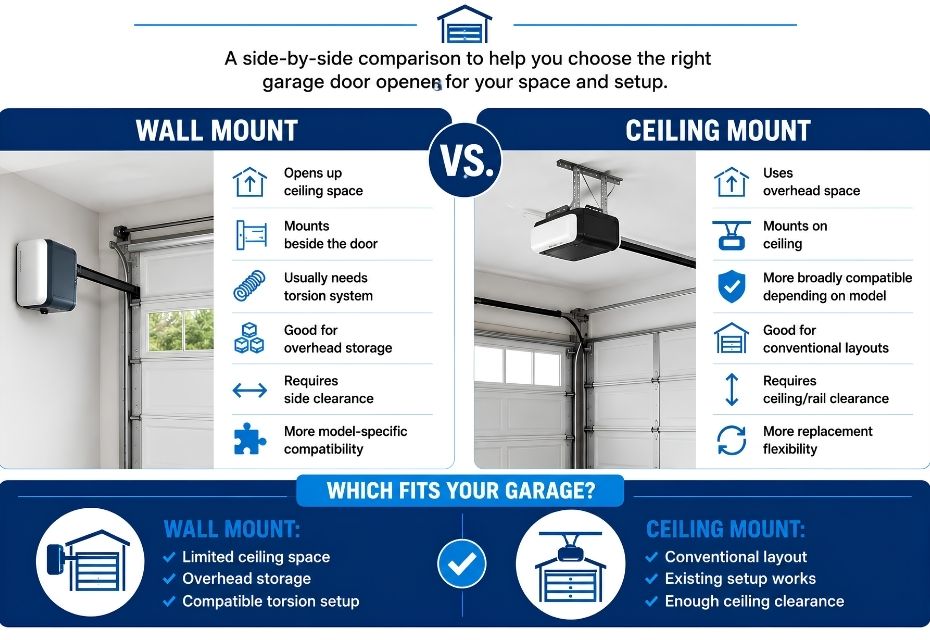
Choose a Wall Mount Opener If:
A wall mount opener may be the better fit if you have a compatible torsion system and:
- You want to free up ceiling space
- Your garage has overhead storage
- The ceiling has obstructions
- You want less equipment hanging overhead
- You are dealing with a garage layout where a ceiling opener is inconvenient
- You are replacing an opener and want a different layout
Choose a Ceiling Mount Opener If:
A ceiling opener may make more sense when:
- Your garage has a conventional layout
- There is sufficient ceiling clearance
- Your existing opener location works well
- You want a straightforward replacement
- Your door uses extension springs
- You do not need the extra ceiling space
The important point is that neither design is universally better.
The better opener is the one that matches the door and the garage.
What About Noise and Maintenance?
Wall mount openers can reduce some vibration compared with certain traditional ceiling-mounted systems, depending on the opener and garage door setup.
But don’t choose an opener based on mounting style alone.
A ceiling-mounted belt-drive opener can be much quieter than an older chain-drive system.
Likewise, a noisy garage door may have nothing to do with the opener.
Worn rollers, loose hardware, poor balance, or other door problems can create noise and vibration regardless of which opener is installed.
Maintenance also depends on the complete system.
The opener, door, springs, rollers, cables, tracks, and other hardware all work together.
Replacing the opener does not correct a garage door that is already binding or poorly balanced.
Does a Wall Mount Opener Have Better Smart Features?
Not necessarily.
Smart features depend on the specific opener model, not simply whether it mounts on the wall or ceiling.
Depending on the model, either type may offer features such as:
- Wi-Fi control
- Smartphone access
- Battery backup
- Remote programming
- Keypad compatibility
- Automatic closing features
- Smart-home integration
Always check compatibility for the exact opener model and accessories you want.
A wall-mounted opener is not automatically more advanced simply because it uses a newer mounting design.
What Are the Wall Mount Garage Door Opener Requirements?
Before choosing one, look at the garage door rather than the opener box first.
1. Check the Spring System
Determine whether the door uses a compatible torsion spring arrangement.
This is one of the most important compatibility checks.
2. Check the Torsion Shaft
The shaft needs to meet the opener manufacturer’s requirements for size, extension, clearance, and condition.
A bent, damaged, unstable, or unsuitable shaft can create problems.
3. Check Side Clearance
There needs to be enough usable space beside the door for the opener and its required hardware.
Do not assume that an empty-looking wall automatically provides enough installation space.
4. Check the Door Balance
The opener is not supposed to compensate for a poorly balanced garage door.
With the opener disconnected, the door should move properly through its travel.
If the door feels unusually heavy or binds, the door system should be addressed before choosing an opener.
5. Check the Door and Drum Configuration
Different garage door configurations can affect whether a particular wall mount opener is suitable.
This is especially important with unusual track, drum, or lift arrangements.
6. Check Power and Accessories
The opener still needs the correct power source and compatible accessories.
Depending on the model, that may include an automatic lock, remote light, battery backup, or other components.
Do not assume accessories from one opener platform will work with another.
What Is the Best Wall Mounted Garage Door Opener?
There is no single wall-mounted opener that is best for every garage.
The right model depends on the door’s weight and configuration, torsion shaft, available side clearance, required features, and manufacturer compatibility requirements.
Instead of choosing an opener only because it has a high horsepower rating or more smart features, start with the door.
A properly matched opener operating a well-balanced door is a better setup than an expensive opener installed on a door that is not mechanically compatible.
Conclusion
A wall mount garage door opener can be a good choice when ceiling space, garage layout, or overhead obstructions are a concern and the door has a compatible torsion system.
A ceiling-mounted opener remains practical for many standard garages, especially when the existing setup works well.
The best choice depends on the garage door and available space, not simply the opener style.
If your garage has limited ceiling space and the door is compatible with a wall mount system, moving the opener to the side can create a cleaner, more open ceiling.
If your existing ceiling-mounted opener works well and you have enough space, there may be little reason to change it.
FAQs
What are the disadvantages of a wall mount garage door opener?
The main disadvantage is compatibility. Wall mount openers generally require a suitable torsion-shaft setup and enough side clearance. They may also require more model-specific hardware than a conventional ceiling-mounted replacement.
Are wall mounted garage door openers worth it?
They can be worth it when you need open ceiling space, have overhead storage, or want a different garage layout. If your existing ceiling-mounted opener works well and space is not an issue, the upgrade may provide less benefit.
Can I convert my existing garage door opener to a wall mount?
You generally replace the existing ceiling-mounted opener with a compatible wall mount opener rather than physically converting the same motor. The garage door’s torsion system, shaft, drums, balance, and available clearance need to be checked first.
What is the best wall mounted garage door opener?
The best model depends on your specific garage door and the features you need. Check torsion-shaft compatibility, door configuration, side clearance, opener capacity, accessories, and smart features before choosing a model.
Can a wall mount opener work with an extension-spring garage door?
A wall mount opener generally requires a compatible torsion system, so an extension-spring door is not normally a direct match. The door may need to be converted to a suitable torsion configuration first.
Is a wall mount opener quieter than a ceiling mount opener?
It can reduce vibration because it does not use the same overhead rail and trolley arrangement. However, a modern belt-drive ceiling opener can also be quiet, so the specific opener and condition of the garage door matter.