A garage door brochure can show you dozens of doors that look almost the same. The choice gets much easier if you make it in order: first how you use the garage, then how the door is built, then the style, and last the details, such as windows, color and hardware.
This guide follows that order. When you have a door in mind and want to compare quotes, our list of eight questions to ask a garage door installer picks up where this one stops. Our garage door installation page describes the doors we install.
Quick answer
Decide how you use the garage before you look at styles. A detached garage used only for parking can do with a simpler door. An attached garage, a room above it or a garage you work in points toward an insulated door. Then choose the style that suits the house: raised panel, flush or carriage-house. Carriage-house is a look: modern carriage-house doors typically open overhead like any other. Check your HOA rules before you settle on a color.
Start with how you use the garage
The same door can be right for one house and wrong for the next. Answer these four questions first:
- Is the garage attached to the house? An attached garage shares at least one wall with the rooms you live in.
- Is there a room above it? A bedroom or game room over the garage feels the door’s temperature and hears its noise.
- Do you use the garage as a room? A workshop, a home gym or a laundry corner needs a more comfortable space than a parking spot does.
- Is it the main way in and out of the house? A door that opens and closes many times a day wears its springs faster, which is worth raising with the installer.
Clopay, one of the large door makers, says a non-insulated door can do the job for homeowners who use the garage mainly for parking and do not mind the temperature swings, and that it suits detached garages. The same guide adds that homeowners in regions with hot summers, or with an attached garage, generally benefit most from a higher R-value. The more of the four questions you answered with a yes, the stronger the case for insulation.
How a steel door is built
The descriptions in this section come from the buying guides of Clopay, the same maker quoted above. It calls steel a top pick for homes because it is strong and needs little upkeep. Two steel doors can look identical from the street and be built very differently inside:
- A single layer. One sheet of steel with nothing behind it. The R-value of a non-insulated door is near zero.
- Steel with insulation panels. Rigid polystyrene panels fit inside the door or between its steel layers. Polystyrene is lighter and usually the more budget-friendly option.
- Steel, foam, steel. Polyurethane foam is injected between two steel skins, where it expands and bonds to them. This gives the highest R-values and stiffens the door.
The layers matter for more than temperature. Insulated doors are quieter and more resistant to dents than non-insulated ones. That is worth weighing if there is a basketball hoop on the driveway, or if you have seen what a hailstorm can do to a thin door.
Three ways to get the look of wood
- Steel with a wood-grain finish. Steel doors come in a range of finishes, including textures that look like wood.
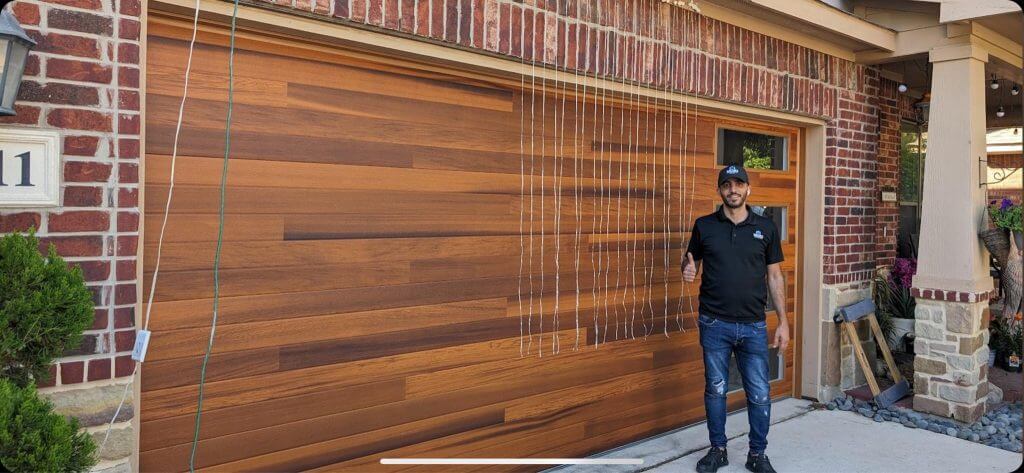
- A composite overlay. Clopay builds its faux-wood doors on an insulated steel door with a moisture-resistant composite overlay molded from real wood boards. These can be painted and, in most cases, stained.
- Real wood. Wood needs the most care: periodic painting or staining to protect it from moisture and sun.
A note on lightweight doors
Aluminum-and-glass doors are light and do not rust, which suits some modern houses. Light doors need extra reinforcement if an opener will be attached. One opener maker’s installation manual says fiberglass, aluminum and lightweight steel doors, and doors with glass panels, need horizontal and vertical reinforcement of the top section before the opener’s door bracket goes on. If you choose a light door, ask whether the quote includes that reinforcement.
How much insulation to pay for
Once you know you want an insulated door, the choice is between the two foams. Polyurethane gives a higher R-value for the same thickness. Polystyrene is usually the less expensive of the two. Compare R-values only between doors measured the same way. Our installer questions explain what an R-value does and does not tell you.
Insulation also adds weight. That is no reason to avoid it, but it means the springs must suit the new door’s weight.
Want a dark finish on a door that gets the afternoon sun? Read the note on bowing under question 2 of our installer questions first. Dark insulated doors in full sun need a word with the installer before you order.
Style: raised panel, flush or carriage-house
Door makers describe three main panel styles.
Raised panel. Rows of symmetrical, raised rectangles. It is the classic look.
Flush and modern. Flat or plank-style panels with clean lines, and aluminum-and-glass doors at the most modern end. Clopay suggests these for mid-century and modern houses.
Carriage-house. These imitate the double doors that once swung open on carriage houses, and Clopay suggests them for craftsman and mission-style homes among others. The swinging is only an illusion. Clopay says modern carriage-house doors typically open up and overhead like standard sectional doors, so you do not lose driveway space. The look comes from the panel pattern, the windows and decorative handles and strap hinges. Carriage-house doors are made in insulated steel, in composite over an insulated steel core and in real wood, so the style does not force a choice between looks and insulation.
The simplest test is to look at the whole house from the street, not at the door alone. Clopay’s advice for one style of house puts it well: choose a door that looks like an original part of the home.
Windows, color and hardware
Windows. They bring daylight into the garage. Insulated glass, two panes sealed with an air space between them, lets through less heat than single glass. If privacy matters, ask about the window position and the glass options before you order.
Color. If your home is in an HOA, its rules may cover garage door colors, styles and windows. Check them before you choose. Our installer questions cover HOA approval and permits.
Hardware. Decorative handles and hinges finish a carriage-house look.
One safety detail. DASMA, the door manufacturers’ association, says that a door without pinch-resistant joints between its sections should have lift handles or safe gripping points inside and out, because people injure their fingers between the sections. Ask if your chosen model has pinch-resistant joints.
What changes along with the door
A new door is more than new panels.
- Track. DASMA advises against putting a new door on the old track. Section thickness, door weight, headroom and the opener’s position can all differ, and the track and sections work as a system.
- Springs. They are chosen for the new door’s weight.
- Opener. Your current opener may still be usable. Ask the installer to check it. Our garage door opener page describes the opener types.
- Size. Clopay gives typical sizes of 8 to 9 feet wide for a single door and 16 feet wide for a double, each 7 to 8 feet high.
Still deciding whether to replace the old door at all? Our guide to when to repair and when to replace a garage door can help.
Frequently asked questions
Is a carriage-house door harder to live with than a regular door?
Not in daily use, if it opens overhead in sections like other doors, as modern carriage-house doors typically do. The look comes from the panels and the hardware. Ask the installer to confirm how the model you like opens.
Do I need an insulated door if my garage is detached?
Not necessarily. Clopay describes non-insulated doors as a fit for detached garages used mainly for parking, while noting that hot-summer regions generally benefit most from a higher R-value. If the detached garage is a workshop you use in July, the answer changes.
Does Mojo install garage doors in my area?
Our service areas page lists the communities around San Antonio. Not sure about your address? Call and ask.
Choosing a new garage door in the San Antonio area?
Call Mojo Garage Door Service at 210-997-7777 for our Hillpoint Dr location or 210-640-9456 for Culebra Rd, or send us a message to ask for an estimate. Our garage door installation page describes the doors we install.
Find us on Google Maps: 10810 Hillpoint Dr, San Antonio or 8034 Culebra Rd, Ste 118, San Antonio.