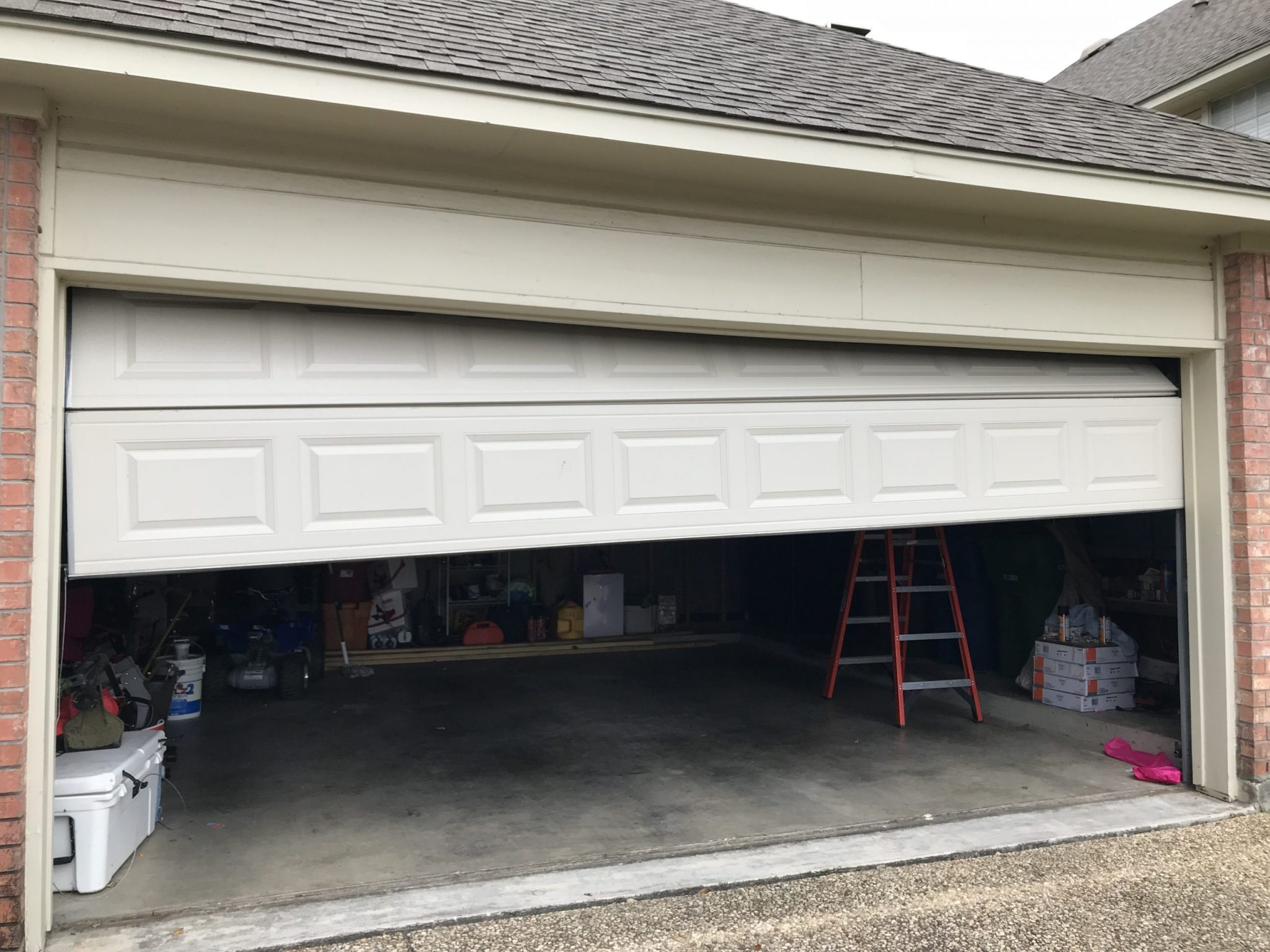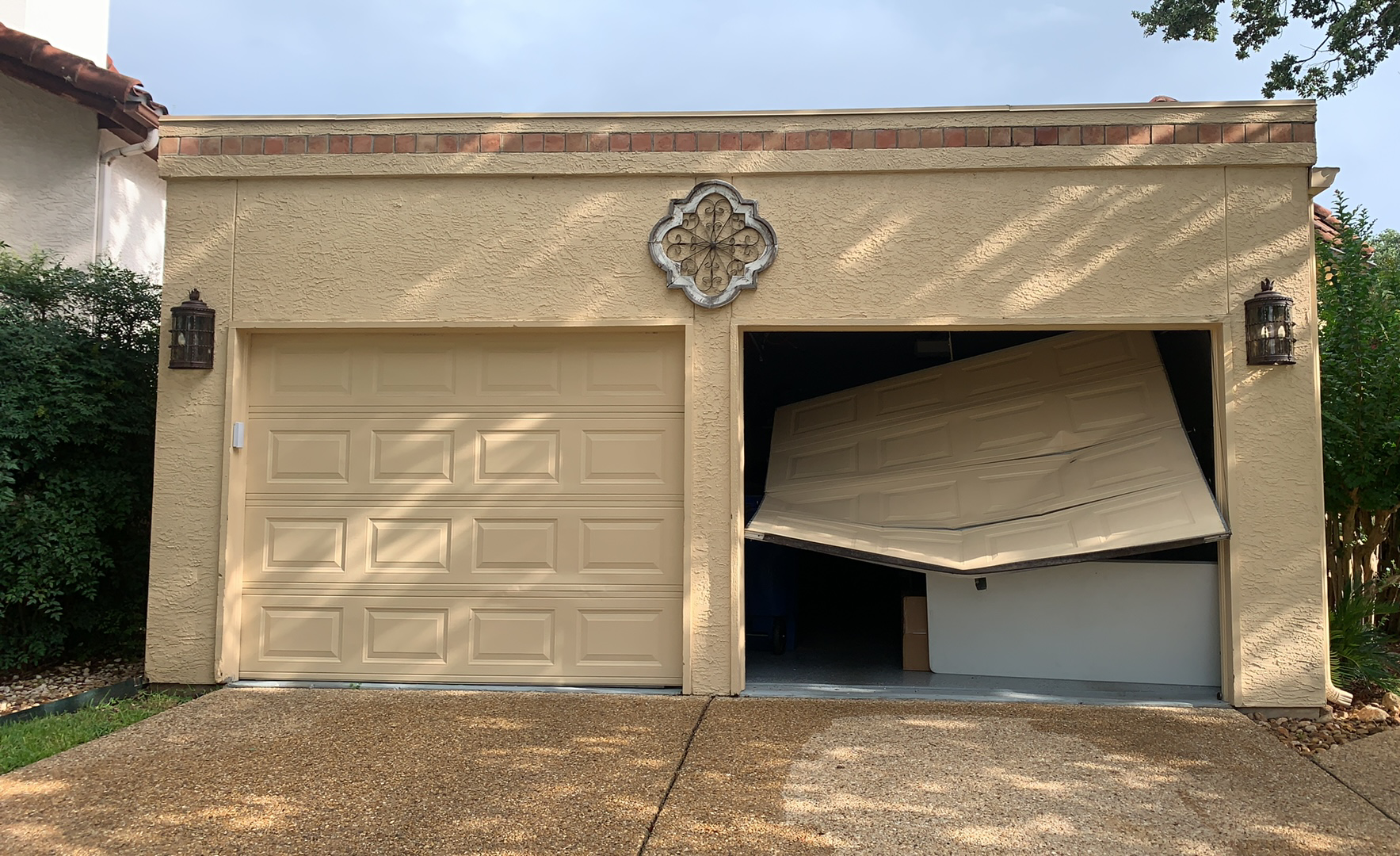
You heard a bang or a scrape, and now the door hangs crooked. A roller has left its track, or a cable is dangling beside the door. Both problems mean the same thing: a heavy door is no longer being held and guided the way it was built to be.
The repair is a job for a trained technician. This guide is about the time before the technician arrives: the short list of things to do, the longer list of things to leave alone, and what to say when you call. Our off-track repair page and our cable repair page explain the repairs themselves.
Quick answer
Stop using the door and the opener. Keep people, pets and cars away from the door and out of the doorway. Do not pull the red emergency release cord. Call a trained garage door technician and describe what you can see. Do not try to push the door back onto its track, lift it, lower it or touch the cables.
What you may be seeing
You do not need to go near the door to know enough for the phone call. From a safe distance, you may see one or more of these:
- The door sits crooked, with one side lower than the other.
- One or more rollers have come out of the track, or a section of track is bent.
- A cable hangs loose beside the door, or has come off its drum at the top.
- The door stopped partway, or the opener ran and the door jammed.
You may also have heard a bang or a scraping noise just before it happened, or seen a car bump the door.
Why the door is dangerous now
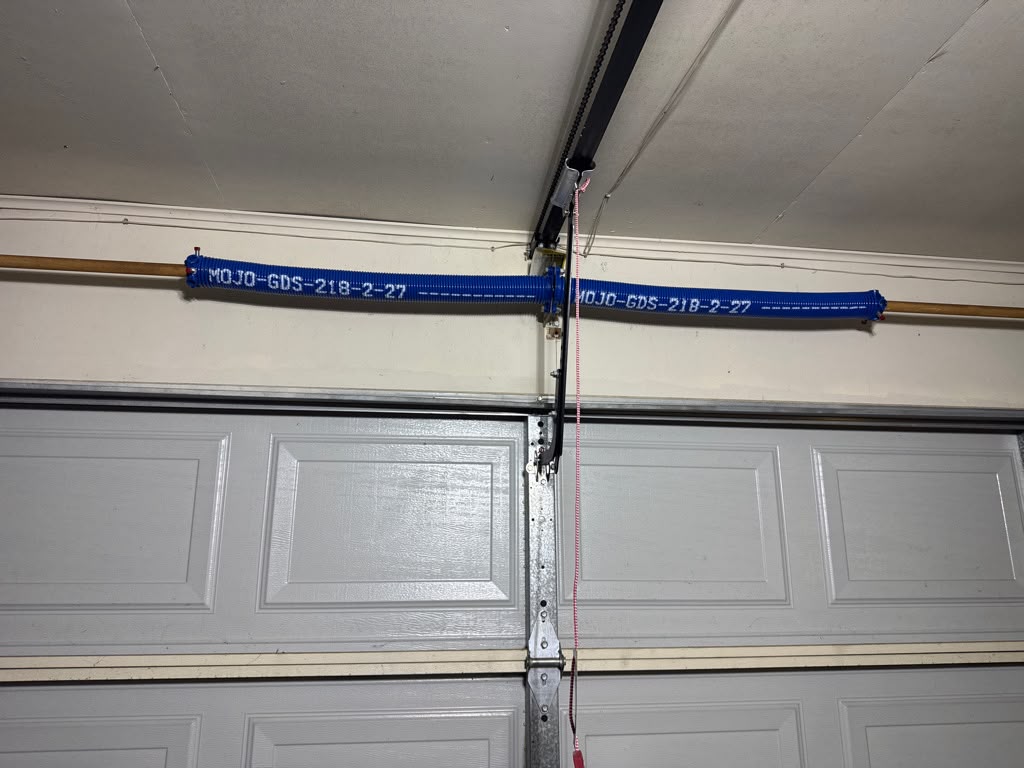
On a sectional door with torsion springs, the lifting is done by two steel cables, one at each bottom corner of the door. Each cable winds onto a grooved drum on the bar above the door, and the springs on that bar supply the lifting force. On doors with extension springs, the cables run over pulleys to springs alongside the tracks. Either way, the rollers keep the door in its tracks.
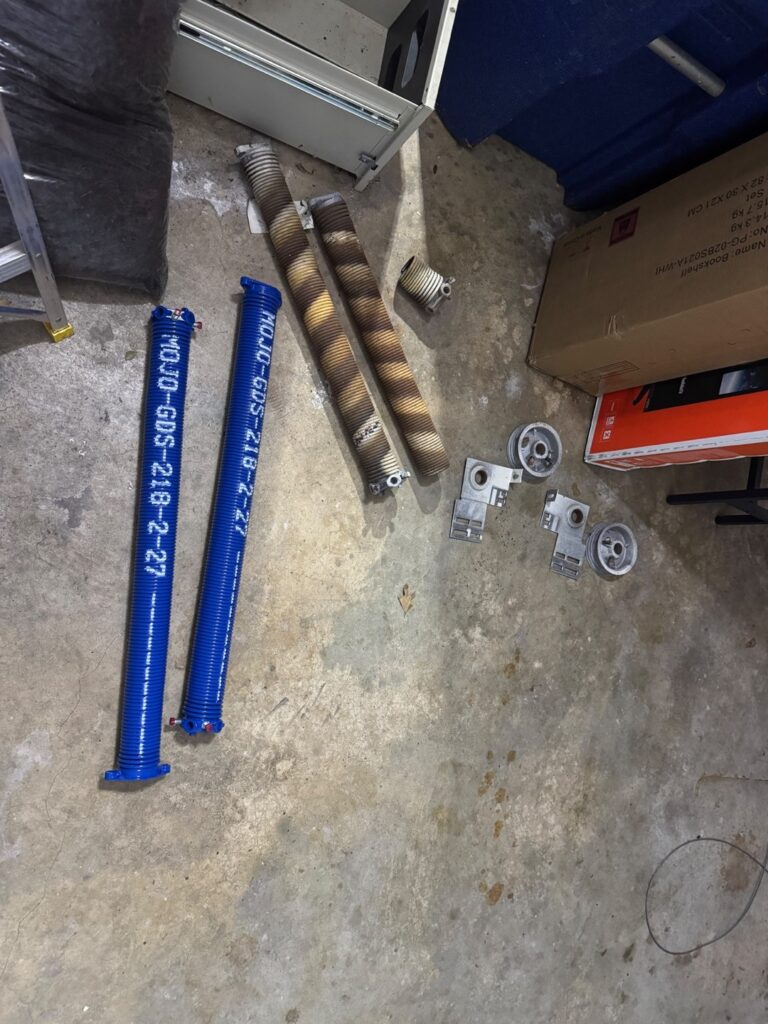
When a cable breaks, one side of the door loses its support while the other side is still held. When rollers leave the track, the door is no longer guided. Either way, its weight is no longer carried evenly. Opener manuals warn that an open door that is out of balance can fall rapidly and unexpectedly if it is released from the opener.
That weight is considerable. According to a data sheet from DASMA, the door manufacturers’ association, a garage door can weigh from about 90 pounds to over 500, depending on its size and how it is built. DASMA’s warning tag for garage doors says the springs, bottom brackets, red-colored fasteners, cables and supports are under extreme tension and can cause serious injury or death.
What to do now: the whole list
- Stop using the door and the opener. Do not press the wall button or a remote to see what happens, and make sure everyone in the house knows not to. Opener manuals say to call a trained technician if a door binds, sticks or is out of balance, and they warn that an unbalanced door may not reverse when it should.
- Keep people, pets and cars clear. Nobody stands or walks under the door or in the doorway, and nobody drives in or out. If a car is inside, leave it there for now.
- Do not pull the red emergency release cord. The cord disconnects the door from the opener. The federal safety standard requires opener manuals to say that the release should be used, if possible, only with the door closed, and that weak or broken springs may let the door fall rapidly. One manufacturer’s manual adds a door that is out of balance to that warning. A door with a broken cable or rollers out of the track is not one to disconnect, whether it is open or closed.
- Call a trained garage door technician. DASMA says worn cables should be replaced only by a trained technician, and the federal standard tells owners to have a qualified service person repair cables, spring assemblies and other hardware.
That is the whole list. Everything else waits for the technician.
What not to touch
- The door itself. Do not push it, lift it, pull it down or try to straighten it.
- The rollers and the track. Do not try to push rollers back into the track, bend or hammer the track, or loosen the brackets that hold it.
- The cables and drums. Do not pull on, cut or rewind a loose cable.
- The springs and bottom brackets. DASMA says bottom brackets are connected to the springs, are under extreme tension and should be adjusted or loosened only by a trained door systems technician.
- Props and clamps. Do not wedge, prop or clamp the door in place.
Online videos can make putting a door back on its track look quick and easy. With a cable gone or a door out of its track, the risk is the door’s weight, and that is not something to test.
If the door is stuck open or partway open
The house may be exposed, but the steps do not change. Leave the door where it is, keep everyone out of the doorway, and do not try to close it by hand or with the release cord. When you call, say that the door is open, so the company knows the house is not secure.
If your car is inside
Leave it where it is. Do not drive out under a door that is crooked or partway open, and do not ask someone to hold the door while you do. Make other plans for getting around, and mention the trapped car when you call. If the door has come down on the car, leave both as they are and keep clear.
What to tell the company when you call
The more precisely you describe it, the more useful the first phone call will be.
- What happened: a bang, a scrape, a bump from a car, or nothing you noticed
- Where the door is now: closed, partway open or fully open
- Which side is lower, and whether a cable is hanging on that side
- Whether rollers are out of the track or a section of track looks bent
- Whether the springs are on a bar above the door or along the tracks, if you know
- Whether a car is inside, and whether the house is open
- Your address or ZIP code
Questions to ask before the repair starts
These are fair questions for any company.
- What caused it? Ask what made the door leave its track or the cable fail, and whether that part is being repaired as well as the door.
- Which parts are being replaced? Ask whether any track section is bent and whether it will be straightened or replaced. If one cable broke, ask what condition the other one is in.
- Will the springs and the balance be checked? The springs carry the door’s weight, so ask the technician to check them and the door’s balance as part of the repair.
- Will the door and the opener be tested afterward? Opener manuals say the safety reversal must be tested after any adjustment. Ask for that test before the technician leaves.
Frequently asked questions
Can I put the door back on its track myself?
No. Leave the door, the track and the cables to a trained technician. The parts that hold the door are under extreme tension, and a door out of its track is not evenly supported.
The door still runs with one cable slack. Is it safe to use?
No. Leave it unused until the cable has been repaired. With one cable slack, the door is not being lifted evenly.
I can see a frayed cable, but the door still works. What should I do?
Stop using the door and call a technician. DASMA says frayed or worn cables are in danger of breaking, and that they should be replaced only by a trained technician.
Does Mojo repair off-track garage doors in my area?
Our service areas page lists the communities around San Antonio. Not sure about your address? Call and ask.
Garage door off its track or a cable snapped in the San Antonio area?
Call Mojo Garage Door Service at 210-997-7777 for our Hillpoint Dr location or 210-640-9456 for Culebra Rd. Tell us what you can see, where the door is and whether a car is inside. Our off-track repair page and cable repair page explain the repairs, and you can also send us a message.
Find us on Google Maps: 10810 Hillpoint Dr, San Antonio or 8034 Culebra Rd, Ste 118, San Antonio.